Thriving Therapist Training Program
Real skills for real practice.
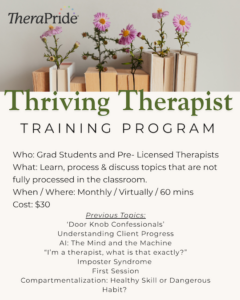 Transitioning from graduate school to clinical practice requires more than textbook knowledge. This monthly, virtual training series is built to equip emerging clinicians and graduate students with the practical tools and professional insight needed to navigate the day-to-day work of mental health. Spearheaded by veteran therapists and leaders in the field, the curriculum addresses the nuanced challenges, high-stakes decisions, and long-term sustainability factors that graduate coursework often leaves out.
Each interactive one-hour module focuses on real-world scenarios and actionable skills. Participants gain direct guidance on mastering intake sessions, managing late-session client revelations, streamlining documentation, integrating emerging technologies like AI, and overcoming imposter syndrome while establishing a focused career path.
Program Instructor
Lisa Kjeseth, MA, LPC-S, LPC, ACS (she/her), with more than 16 years on the ground, has created this series out of a deep, personal passion. She cares about helping new clinicians prepare for real practice. Graduate school covers the requirements. It rarely covers the reality.
Lisa spent years supervising interns and associate therapists. She saw the same pattern over and over. People step into the field and suddenly realize how much they have to figure out on the fly.
You should not have to learn everything through trial and error.
Certain conversations belong in your training. You need to know how to form your professional identity. You have to process the emotional weight of this work, set firm boundaries, spot burnout early, and recover when you make mistakes. That is how you build a long-term career without losing yourself along the way.
Burnout rates are climbing while community needs keep surging. Lisa built this series to invest in the people stepping up to meet that need. She will not tell you who to be. Instead, she gives you the space to ask sharper questions, build actual skills, and step confidently into your own style.
Training Sessions:
- September 30, 2026: What Goes Into a First Session?
- October 7, 2026: Beyond Self-Care: How to Survive and Thrive in This Career: Part I
- November 11, 2026: Finding My Specialty
- January 6, 2027: Imposter Syndrome
- February 10, 2027: Beyond Self Care: How to Survive and Thrive in This Career Part 2
- March 10, 2027: SOAP Notes
- April 14, 2027: What is my Job?
- June 9, 2027: Door Knob Confessionals: "oh one more thing..."
- July 14, 2027: Mind and Machine: AI and Therapy
- August 11, 2027: Noting Client Progress: "Seeing the Shift: Noting Growth in Therapy"
Who It Is For: Graduate students, interns, and pre-licensed mental health professionals.
When: Every second Wednesday of the month, 10:00 AM to 11:00 AM CST (starting September 2026).
Where: Live virtual sessions.
Cost: $30 per session (discount available when enrolling for a full semester).
Registration: Complete the Thriving Therapist Enrollment Form to reserve your spot.
Curriculum
September
Wednesday, Sept 30th 9/10am (MDT/CDT)
Title: What Goes Into a First Session?
Description: You only get one first session; so let’s make it count.
Graduate school teaches you the assessment and paperwork, but what about the actual human connection? This one-hour training covers real-life moments that aren’t always taught in the classroom: what to say, what to ask, what to explain, and what not to do.
Learn how to build trust, navigate boundaries and confidentiality, set expectations, and create a truly collaborative space where clients feel heard, comfortable, and empowered.
Come for the practical tips. Stay for the “why didn’t anyone teach us this?” moments. Leave with language and strategies you can use in your very next first session.
October
Wednesday, October 7th 9/10am (MDT/CST)
Title: Beyond Self-Care: How to Survive and Thrive in This Career: Part I (Part 2 in Spring 2027)
Description: You’re learning how to take care of your clients. But who’s teaching you how to take care of YOU?
Therapy is meaningful work; but it can also get heavy. This one-hour training goes beyond the typical “practice self-care” advice and gets real about what happens when your clients’ stories, struggles, and crises start following you home.
We’ll break down burnout, compassion fatigue, secondary trauma, and vicarious trauma, learn the warning signs you don’t want to ignore, and explore the unique ways therapists can slowly become depleted; even when they love what they do.
Come learn how to protect your passion, recognize when you’re running on empty, and build a career you can actually sustain.
November
Wednesday, November 11th, 9/10am (MST/CST)
Title: Finding My Specialty
Description: You don’t have to know your specialty when you graduate. But learning what pulls you in, what fits you, and what kind of therapist you want to become can change the direction of your career. This interactive training helps you move beyond simply listing your interests and start identifying where you might want to go deeper.
You’ll explore your strengths, experiences, temperament, passions, and potential triggers, narrow your interests, and begin shaping a specialty that feels both personally meaningful and professionally sustainable. We’ll also talk honestly about imposter syndrome, finding your people, and figuring out what actually fits with practical next steps for exploring your options through training, internships, and real-world experience.
January
Wednesday, January 6th, 9/10am (MST/CST)
Title: Imposter Syndrome
Description: You can know the theory, pass your classes, get positive feedback and still wonder, “What if everyone realizes I have no idea what I’m doing?” Imposter syndrome is incredibly common in the therapy profession, but it doesn’t have to define how you show up as a clinician.
This training takes an honest look at why therapy is such fertile ground for self-doubt, how to tell the difference between healthy clinical humility and imposter syndrome, and what to do when that inner critic gets loud. We’ll explore perfectionism, comparison, mistakes, supervision, consultation, and the pressure to always have the “right” intervention while reframing uncertainty as part of becoming a thoughtful clinician.
February
Wednesday, Febrcuary 10th 9/10am (MST/CST)
Title: Beyond Self Care: How to Survive and Thrive in This Career Part 2
Description: We all know the language: self-care, boundaries, burnout, supervision, work-life balance. But knowing the concepts and knowing how to actually use them in your life as a therapist are two very different things.
In Part 2, we take these familiar ideas deeper and look at them differently. We’ll explore what it really means to restore yourself rather than simply recover enough to keep going, how your work can deplete you in ways you don’t always notice, and how to protect the time, energy, money, and emotional investment you’ve made in becoming a therapist. We’ll examine counselor identity, vicarious trauma, boundaries, professional support, and the difference between simply getting through this career and creating one that continues to feel meaningful.
This is the conversation beyond “take care of yourself.” It’s about learning to recognize what you need, understanding what this work takes from you, and intentionally building a professional life that gives something back.
This isn’t another lecture about bubble baths and work-life balance. It’s a conversation about how we keep doing work that matters without allowing the work to consume us. What it means to find true Professional Sustainability.
March
Wednesday, March 10th , 9/10am (MST/CST)
Title: SOAP Notes
Description: SOAP notes are something every therapist has to write but few of us are actually taught how to write them well. This practical training takes the guesswork out of documentation and shows you how to turn the SOAP format into a clear, concise clinical story that captures what happened, why it matters, and what comes next.
Learn how to write notes that are clinically meaningful, ethically sound, person-centered, and defensible without overthinking every sentence. Leave feeling more confident, capable, and ready to put your documentation skills to work.
April
Wednesday, April 14th, 9/10am (MDT/CDT)
Title: What is my Job?
Description: At some point in training, you stop asking “How do I become a therapist?” and start asking a much harder question: “What does it actually mean to be one?”
This training takes an honest look at therapist identity, emotional boundaries, burnout, rescuing, responsibility, and the pressure to get it “right.” We’ll explore how to care deeply without carrying your clients’ lives, stay connected without losing yourself, and use your clinical expertise without taking away your client’s autonomy.
Most importantly, we’ll challenge some of the assumptions therapists quietly carry into the room including the powerful “the client should…”and examine how our values, biases, and need to help can shape our work.
June
Wednesday, June 9th, 9/10am (MDT/CDT)
Title: Door Knob Confessionals: “oh one more thing…”
Description: Every therapist has experienced it: the session is over, the client is halfway out the door and suddenly, something important comes up. A “quick” disclosure can leave you wondering what to do, how to respond, and how to avoid either rushing into it or accidentally reinforcing the pattern.
This practical training explores the why behind the door knob confessional and what these moments can tell us about safety, boundaries, avoidance, attachment, and the therapeutic relationship. You’ll learn how to respond with curiosity and compassion while still holding appropriate boundaries, and how to turn these end-of-session moments into clinically meaningful information rather than an awkward scramble to end the session.
Because sometimes “one more thing” is actually the most important thing they say all hour.
July
Wednesday, July 14th , 9/10am (MDT/CDT)
Title: Mind and Machine: AI and Therapy
Description: AI is already changing the way therapists work but what happens when technology enters the therapy room? This training moves beyond the hype and fear of AI to explore what it can actually offer clinicians, where it falls short, and what we risk when we let technology do too much of the work.
We’ll look at documentation, clinical support, AI-assisted interventions, confidentiality, bias, ethics, skill development, and the future of the profession, while asking a bigger question: What parts of therapy can technology support and what parts must remain deeply human?
August
Wednesday, August 11th, 9/10am (MDT/CDT)
Title: Noting Client Progress “Seeing the Shift: Noting Growth in Therapy”
Description: What does progress in therapy actually look like? It’s not always a dramatic breakthrough or a client walking into a session saying, “I’m all better.” Sometimes growth is quieter: a new coping skill, a healthier relationship, more emotional flexibility, greater insight, or simply doing something today that felt impossible six months ago.
This practical training helps you look beyond symptom checklists and learn to recognize, measure, document, and communicate meaningful change. We’ll explore the subtle ways clients grow, why progress isn’t always linear, how to use both clinical tools and client feedback, and how recognizing progress can strengthen both your clients’ confidence and your own as a developing therapist.

Ready to talk? Speak with a Therapride staff member to start your journey to wellness.